● refactoringbuilding/projects/aria · v0.1
ARIA
● open source · multi-agentAutonomous Residential Intelligence Agent. Millions of home batteries, one coordinated brain. A hierarchical multi-agent system that runs a home's energy autonomously — reading live AEMO prices, scheduling the battery, shifting load, watching the grid, and trading spare power with the street — and explains every decision in plain English.
Context
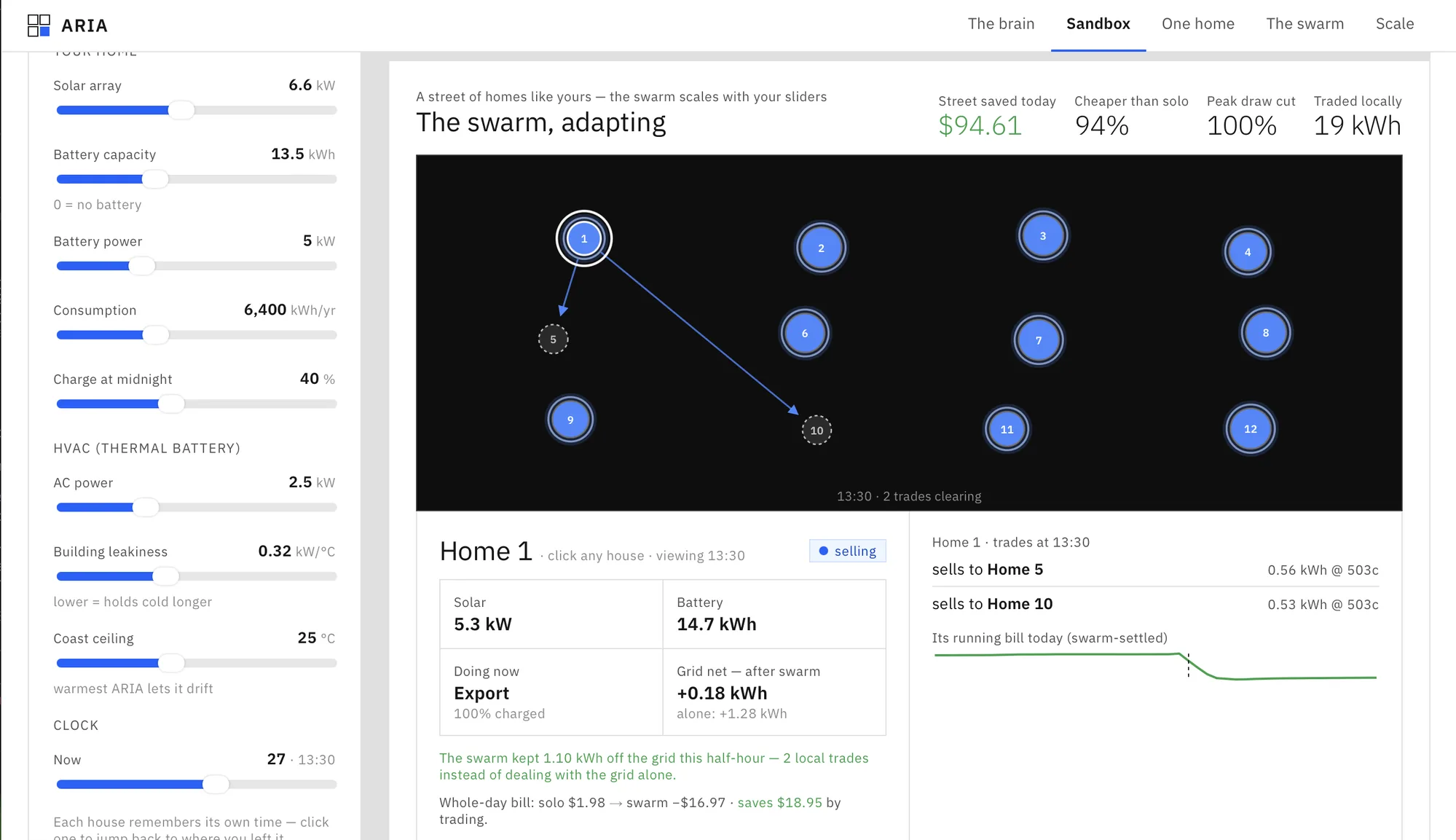
Australia is heading toward millions of home batteries with no coordination layer — each one optimising in isolation, blind to the grid and to its neighbours. ARIA is the answer to “what if they shared a brain?” It was backtested against the real 13 February 2024 AEMO VIC1 market-price-cap day. A single managed home charged overnight and discharged into the $16.60/kWh spike to net roughly $120 in credit — about $61 ahead of an unmanaged solar-only home. Scaled to a 12-home neighbourhood, direct peer-to-peer trading cut peak draw 100% and beat solo operation 94% of the time. Every number on the dashboard is a real settled outcome, not a projection.
The six agents
01Forecasting
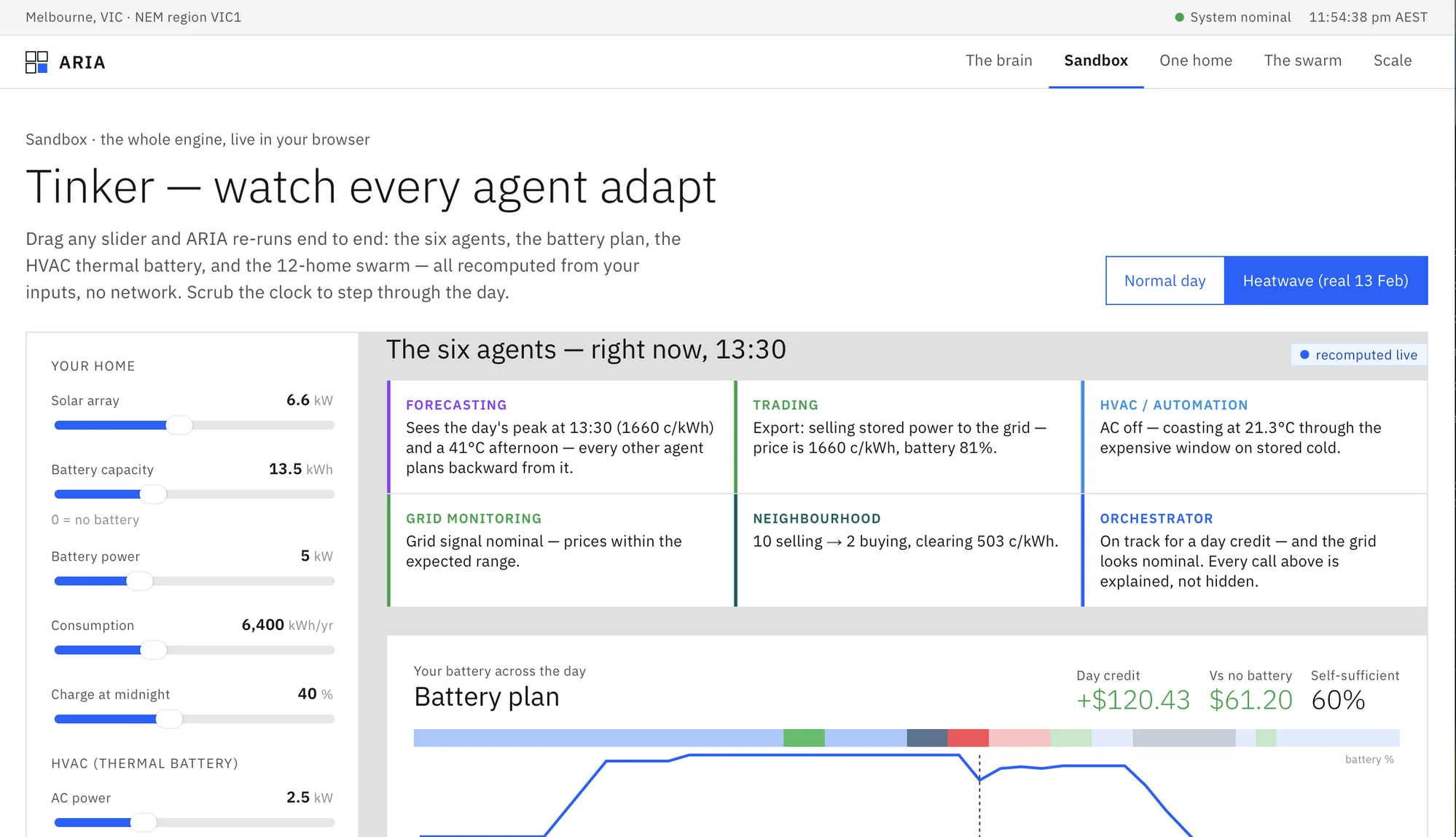
Reads the day's price and weather, sees the peak ahead, and plans every other agent backward from it.
02Trading
Decides when to import, hold, or export — selling stored power into the spike, buying when it's cheap.
03HVAC / automation
Treats the building as a thermal battery — pre-cools, then coasts through the expensive window on stored cold.
04Grid monitoring
Watches for anomalies: prices outside the expected range flip the system out of nominal.
05Neighbourhood
Clears peer-to-peer trades across the street — 10 selling → 2 buying — so energy stays local instead of hitting the grid.
06Orchestrator
Coordinates the five specialists toward a day credit and surfaces a plain-English reason for every call. Nothing hidden.
The sandbox
The whole engine runs live in the browser. Drag any slider — solar array, battery capacity, HVAC thermal mass, charge-at-midnight — and ARIA re-runs end to end: the six agents, the battery plan, the thermal model, and the 12-home swarm, all recomputed from your inputs with no network. Scrub the clock to step through the day.
Key technical decisions
01one unified TypeScript app › separate microservices per agent
Every agent, the battery plan, the HVAC thermal model, and the 12-home swarm live in one Next.js app and recompute together. For a system that has to stay coherent across agents, simplicity and robustness beat modularity — there are no network hops to fail mid-decision.
02ReAct loop with plain-English traces › opaque optimiser
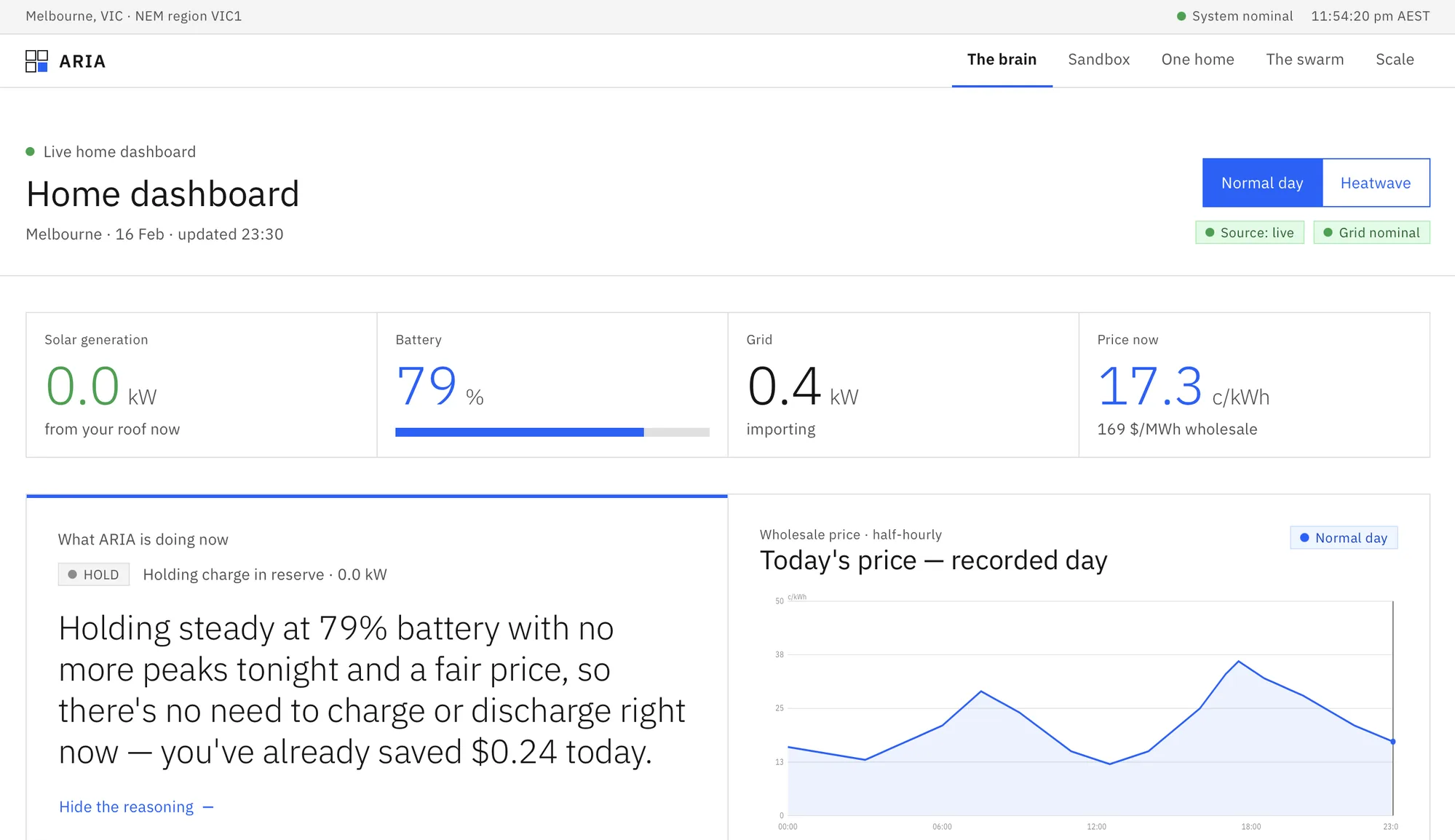
Every agent reasons then acts, and writes down why. The dashboard shows "what ARIA is doing now" as a sentence, not a number. A home-energy system people will trust has to explain itself — the explanation is a first-class output, not an afterthought.
03client-side recompute › server round-trip per slider
The Sandbox runs the whole engine in the browser. Drag solar size, battery capacity, or charge-at-midnight and all six agents plus the swarm re-run end-to-end with no network — the model is fast and transparent enough to live entirely client-side.
04seed-cache fallback › hard dependency on live feeds
Live AEMO prices, Google Solar, and BOM weather drive the system, but a recorded "seed cache" backs every source. If a feed dies the demo still runs on real recorded data — reliability over freshness when the network is the weak link.
Stack
AppNext.js · React · TypeScript · IBM Carbon design system
AgentsClaude (primary) or OpenAI · ReAct reason-and-act loop
ForecastChronos-2 (optional upgrade)
DataAEMO prices · Google Solar API · BOM weather · seed-cache fallback
DeployVercel